Showing posts with label Amplifiers. Show all posts

Mic Audio Amplifier Circuit Diagram

The compact, low-cost condenser mic audio amplifier described here provides good-quality audio of 0.5 watts at 4.5 volts. It can be used as part of intercoms, walkie-talkies, low-power transmitters, and packet radio receivers. Transistors T1 and T2 form the mic preamplifier. 

Resistor R1 provides the necessary bias for the condenser mic while preset VR1 functions as gain control for varying its gain. In order to increase the audio power, the low-level audio output from the preamplifier stage is coupled via coupling capacitor C7 to the audio power amplifier built around BEL1895 IC.BEL1895 is a monolithic audio power amplifier IC designed specifically for sensitive AM radio applications that delivers 1 watt into 4 ohms at 6V power supply voltage. 

It exhibits low distortion and noise and operates over 3V-9V supply voltage, which makes it ideal for battery operation. A turn-on pop reduction circuit prevents thud when the power supply is switched on. Coupling capacitor C7 determines low-frequency response of the amplifier. Capacitor C9 acts as the ripple-rejection filter.

Mic Audio Amplifier Circuit Diagram
.
Condenser Mic Audio Amplifier Circuit Diagram

Capacitor C13 couples the output available at pin 1 to the loudspeaker. R15-C13 combination acts as the damping circuit for output oscillations. Capacitor C12 provides the boot strapping function. This circuit is suitable for low-power HAM radio transmitters to supply the necessary audio power for modulation. With simple modifications it can also be used in intercom circuits.


Author: D. Prabakaran - Copyright: Electronics For You Mag

Small Audio Amplifiers Using LM386 and NE5534

Many electronic projects require the use of a small audio amplifier. Be it a radio transceiver, a digital voice recorder, or an intercom, they all call for an audio amp that is small, cheap, and has enough power to provide adequate loudness to fill a room, without pretending to serve a disco! About one Watt RMS seems to be a convenient size, and this is also about the highest power that a simple amplifier fed from 12V can put into an 8 Ohm speaker. A very low saturation amplifier may go as high up as 2 Watt, but any higher power requires the use of a higher voltage power supply, lower speaker impedance, a bridge circuit, or a combination of those.

During my many years building electronic things I have needed small audio amps many times, and have pretty much standardized on a few IC solutions, first and and foremost the LM386, which is small, cheap, and very easy to use. But it does not produce high quality audio... For many applications, the advantages weigh more than the distortion and noise of this chip, so that I used it anyway. In other cases I used different chips, which perform better but need more complex circuits. Often these chips were no longer available the next time I needed a small amplifier.

When I last upgraded my computer, I replaced the old and trusty Soundblaster AWE 32 by a Soundblaster Audigy. The new card is better in many regards, but while the old one had an internal audio power amplifier, the new one doesn't! That's bad news, because I have some pretty decent speakers for the PC, which are fully passive. So, I built a little stereo amp using two LM386 chips and installed it inside the computer, fed by the 12V available internally.

But then I wasn't satisfied. The LM386 might be suitable for "communication quality" audio, which is roughly the fidelity you get over a telephone, but for music it's pretty poor! The distortion was awful. So, the day came when I decided to play a little more scientifically with small audio amps, looking for a way to get good performance with simple and inexpensive means.

I set up a test bench with a sine wave oscillator running at 1 kHz, an 8 Ohm speaker, 12V power supply, and the computer with the soundcard and Fast Fourier Transform software. One channel was connected to the oscillator together with the amplifier input, the other channel to the output and speaker. With this setup I measured the harmonic content of the audio signals. I did the tests at an output level of 0.1W, which is typical for moderately loud sound from a reasonably efficient speaker. Also, I used a music signal from a CD player to test the actual sound of each amplifier.

Circuit Project: Small Audio Amplifiers Using LM386 and NE5534

As already said above, the main attraction of the LM386 is the extreme simplicity of its application circuit. You can even eliminate R1 if the signal source is DC-grounded. If the speaker leads are long, you should add an RC snubber across the output to aid stability. Additionally, if you need higher gain (not necessary if the input is at line level), you can connect a 10uF capacitor between pins 1 and 8. That's about all there is to it.

Now the bad news: This circuit produced a very high level of distortion! The second harmonic measured just -28dB from the main output. The third harmonic was at -35dB, while the noise level was at -82dB. There were assorted high harmonics at roughly -45dB. With music, the distortion was really disturbing, and also the noise level was uncomfortably high. The power supply rejection is poor, so that some hum and other supply noise gets through. In short, this was a lousy performance!

Since I had used so many LM386s in my projects, I had several different variations. In my material box I found a slightly newer LM386N-1. So I plugged it into my test amplifier. It was even worse! The second harmonic was at -24dB, the third harmonic at -31dB, while the noise was a tad better at -84dB. Folks, that's a total harmonic distortion of almost 7%! And the 0.1W output level at which this was measured is where such a circuit is about at its best...  The distortion can be plainly seen on the oscilloscope, and a visibly distorted waveform is about the most offending thing an audio designer can ever see!

Looking through my projects, I found one where I had used a GL386 chip. This is just a 386 made by another company. I unsoldered it and put it in my test amplifier. Surprise! It was dramatically better, with the second harmonic at -45dB, and the third at -57dB! The noise floor was -84dB, just like the LM386N-1. But even this level of distortion was plainly audible when listening to music. That's roughly 0.6% THD. Some folks may consider it acceptable for music. I don't, but for communication equipment it's fine. At this point, I decided to see if I could build a better amplifier, that doesn't become too complex nor expensive.

Circuit Project: Small Audio Amplifiers Using LM386 and NE5534

This was the first attempt. A low distortion, fast slew rate, but easy to find and rather inexpensive operational amplifier, driving a simple source follower made of two small transistors. These transistors are not biased, so they work at zero quiescent current, in full class B. The only mechanism that works against crossover distortion here is the high slew rate of the OpAmp, which is able to make the distortion bursts during crossover very short. To say the truth, I didn't expect to get usable performance from this circuit, and was really surprised when it worked much better than the 386! The second harmonic was at -77dB, the third at -79dB!

Also there were many high harmonics at roughly -84dB. That means a THD of about 0.015%.  The noise floor was down at the -120dB level! The power supply rejection was excellent, with no detectable feedtrough. Playing music, this amplifier sounded really good: No audible noise, and the distortion could be heard when paying attention to it, but I doubt that the average person would detect it! Not bad, for a bias-less design!

Just to see how important the slew rate of the OpAmp is, I pulled out the NE5534 and replaced it by a humble 741, which is many times slower. The result was dramatic: The second harmonic still good at -70dB, but the third harmonic was much worse, at -48dB. Also there were many high harmonics at the same -48dB level. Given that second harmonic distortion doesn't sound bad to most people, but third harmonic does, and high harmonics are even worse, it came as no surprise that the amplifier with the 741 sounded bad.

At low volume it sounded particularly bad! So I returned to the oscillator and measurement setup, testing at lower output power, and found that while the second and third harmonics followed the output, the high harmonics stayed mostly constant! So, at very low output, the high harmonics became very strong relative to the output. All this is the effect of the slower slew rate of the 741, which makes it less effective correcting the crossover distortion of the unbiased transistors. Interestingly, the noise floor of the 741 circuit wasn't bad: -118dB.

Just for fun, I tried this circuit with a third OpAmp: The TL071, which is good, but not as good as the 5534. The results: Second harmonic at -72dB, third and the high ones at -60dB, and the noise at -120dB. It's interesting that the second harmonic is much more suppressed than the third one. That must be a balancing effect of the symmetric output stage, and the better symmetry in the TL071 compared to other OpAmps.

It's worthwhile to note that this amplifier can be simplified a lot by using a split power supply. R1, R2, C1, C2 and C4 would be eliminated! But then you need the capacitor removed from C4 to bypass the negative supply line. The positive input of the chip goes to ground, while pin 4 and the collector of Q2 go to the negative supply. The rest stays the same. If you use a +-15V supply, the available RMS output power grows to over 10 Watt! Of course, you then need larger transistors. And since larger transistors are slower, the distortion will rise somewhat. An added benefit of a split supply is that the popping noise when switching on and off is eliminated.

Circuit Project: Small Audio Amplifiers Using LM386 and NE5534

As the next experiment, I decided to get rid of the crossover distortion. For this purpose, I added a traditional adjustable bias circuit with a transistor and a trimpot. Now I also had to add a current source, because with the bias circuit there is no single point into which the OpAmp could put its drive current into both bases! I adjusted the bias for the best distortion, and this was really  a good one! The second harmonic was down right where the test oscillator delivered it, about -80dB, so I couldn't really measure it!

The third harmonic was at -84dB, and the best improvement was that the higher harmonics had simply disappeared! They were all below the noise floor, which stayed at -120dB. Actually, this noise floor seems to come from the soundcard A/D converter, so that the actual noise of this and the above amplifier may even be better! With music, this amplifier sounded perfect - clean and smooth. And I'm pretty confident that the THD is well below the limits of my measurement setup, which is 0.01%.

The quiescent current was around 10mA. When lowering it to about 3mA, the high harmonics started to rise out of the noise floor. If you want to adjust the bias for the exact best quiescent current, there is a simple trick: Lift R4 from the output, and connect it to pin 6. Now the output stage has been left outside the feedback loop, and all its distortion will show up at the output. Watching the signal on an oscilloscope, or even better on a real time spectrum analyzer (soundcard and software), adjust the trimpot to the lowest distortion level.

Have a current meter in the supply line and make sure that you don't exceed 30mA or so of quiescent current, in order to keep the small transistors cool. But most likely the best distortion will be at a current lower than that. Once the adjustment is complete, return R4 to its normal position. Now the full gain and slew rate of the operational amplifier is used to correct the small remaining cross-over distortion of the output stage, and the distortion will certainly disappear from the scope screen, from your ears, and possibly fall below the detection level of the spectrum analyzer!

This circuit can also be run from a split power supply, by exactly the same mods as for the previous circuit. And since the transistors are properly biased, there isn't any significant distortion increase when using larger transistors. Be sure to use some that have enough gain - you have only a few mA of driving available, and with a +-15V power supply and an 8 Ohm speaker, there can be almost 2A of output current! So, you need a gain of 300 at least. There are power transistors in the 4A class that provide such gain, and these are good candidates. The other option is using Darlington transistors, which far exceed the gain needed here. But they will again increase the distortion, not very much, but perhaps enough to make it audible again.

Source: Humo Luden

20 Watt Power Amplifier

This IC chip was designed specifically for use in power boosting applications in automobiles. It is self protecting against short circuits and thermal problems. In the bridge configuration shown it will deliver 20 watts of power into a 2 ohm speaker operating at 14.4 volts.

20 Watt Power Amplifier  Circuit Diagram

20 Watt Power Amplifier circuit diagram

LM4910 Stereo Headphone Amplifier

LM4910 belonging to the Boomer series of National Semiconductors is an integrated stereo amplifier primarily intended for stereo headphone applications. The IC can be operated from 3.3V ans its can deliver 0.35mW output power into a 32 ohm load. The LM4910 has very low distortion ( less than 1%) and the shutdown current is less than 1uA. This low shut down current makes it suitable for battery operated applications. The IC is so designed that there is no need of the output coupling capacitors, half supply by-pass capacitors and bootstrap capacitors. Other features of the IC are turn ON/OFF click elimination, externally programmable gain etc.


LM4910 Stereo Headphone Amplifier  Circuit Diagram


LM4910 - Stereo Headphone Amplifier
Circuit diagram of the LM4910 stereo headphone amplifier is shown above.C1 and C2 are the input DC decoupling capacitors for the left and right input channels. R1 and R2 are the respective input resistors. R3 is the feed back resistor for left channel while R4 is the feed back resistor for the right channel. C3 is the power supply filter capacitor. The feedback resistors also sets the closed loop gain in conjunction with the corresponding input resistors.

Notes.
  1. The IC is available only in SMD packages and care must be taken while soldering.
  2. The circuit can be powered from anything between 2.2V to 5V DC.
  3. The load can be a 32 ohm headphone.
  4. Absolute maximum supply voltage is 6V and anything above it will destroy the IC.
  5. A logic low voltage at the shutdown pins shut downs the IC and a logic high voltage at the same pin activates the IC.

STK4050 Audio Amplifier with 200W Output

The project is based around the hybrid integrated circuit STK4050 manufactured by Sanyo to build a low noise mono audio amplifier with complete high quality. The project has a maximum output power of 200W while incorporating a volume control. The power supply used in the circuit is an on-board type and because of this, only a center tapped transformer is needed for the powering of the circuit. The sound has a very good quality and it can be proven when used in home theaters, in computers, and other audio equipments which can also be used as subwoofer amplifier. For thin-type audio sets, it can be considered as a compact package.

STK4050 Audio Amplifier with 200W Output

The heat generated in thin-type audio sets is being dispersed easily with a good heatsink design. There may be case where a shock noise may be encountered especially during switch ON and switch OFF. This can be reduced by providing a constant current circuit. The design of the circuit can be tailored for reducing occurrence of thermal shutdown, short circuit protection for loads, shock noise muting from external power supply. The load resistance should have 8 Ohms value with 55K Ohms input impedance.

10W Stereo Audio Amplifier Using TDA2009A

This is a schematic of a 10W stereo audio amplifier using TDA2009A amplifier IC. TDA2009A is a good IC provides quality sound. It has built in features like output current protection and thermal protection etc. The circuit can be operate between 8 to 24V DC with 1 to 2 amphere.

10W Stereo Audio Amplifier Circuit Diagram :


10w-stereo-amplifier-circuit-diagram

If you want to operate this 10 watt amplifier circuit with watt amplifier circuit with mains supply then use a filtered and stable power supply to reduce mains hum. 10 watt out put power can be obtained by providing 20V 1.5A to the circuit. Use good and thick heatsink with the IC. 

Adaptor for Bass Guitar Amp

These days, music is a major hobby for the young and not-so-young. Lots of people  enjoy  making  music,  and  more  and  more dream of showing off their talents on stage. But one of the major problems often encountered is the cost of musical equipment. How many amateur music groups sing  through an amp borrowed from a guitarist or bass player? 

This is where the technical problems arise not in terms of the .25” (6.3 mm)  jack, but in terms of the sound quality (the words  are barely understandable) and volume (the amp  seems to produce fewer decibels than for a guitar). What’s more, unpredictable feedback may cause damage to the speakers and is very unpleasant on the ear. This cheap little  easy-to-build project can help solve these technical  problems.
.
Adaptor for Bass Guitar Amp Circuit diagram :

Vocal Adaptor for Bass-Guitar Amp-Circuit Diagram
Vocal Adaptor for Bass Guitar Amp Circuit Diagram

A guitar (or bass guitar) amplifier is designed first and foremost to reproduce the sound of the guitar or bass as faithfully as  possible. The frequency response of the amp doesn’t need to be as wide or as flat as in hi-fi (particularly at the high end), and so this sort of amplifier won’t permit faithful reproduction of the voice. 

If you build an adaptor to compensate for the amp’s limited frequency response by amplifying in advance the frequencies that are  then attenuated by the amp, it’s possible to  improve the quality of the vocal sound. That’s  just what this circuit attempts to do. 

The adaptor is built around the TL072CN low-noise dual FET op-amp, which offers good value for money. The NE5532 can be used with almost the same sound quality, but at (slightly) higher cost. The circuit breaks  down into two stages. The first stage is used to match the input impedance and amplify the microphone signal. 

For a small 15 W guitar or bass amplifier, the achievable gain is  about 100 (gain = P1/R1). For more powerful amplifiers, the gain can be reduced to  around 50 by adjusting P1. The second stage amplifies the band of frequencies (adjustable using P2 and P3) that are attenuated by the guitar amp, so as to be able to reproduce the (lead)  singer ’s voice as clearly, distinctly, and  accurately as possible. To refine the adaptor and tailor it to your amplifier and speaker, don’t be afraid to experiment with the component values and the type  of capacitors. 

The circuit can readily be powered using a 9 V battery, thanks to the voltage divider R4/R5 which converts it into a symmetrical  ±4.5 V supply.


source by streampowers

Stereo Power Amplifier Using IC 7905

79xx is a widely known series of low-cost, fixed-negative-voltage regulators. These integrated circuits are available with output current of 100-150 mA (L series), 0.4-0.5A (M series), up to 1A (standard series), etc. They can be used in many applications other than regulators, audio power amplifier being one of them.  As shown in the circuit diagram, a simple stereo audio amplifier is built around two 7905 negative-voltage regulators (IC1 and IC2) and a few discrete components. The 7905 IC (a -5V regulator) used here is readily available. However, the circuit will also work with other 79XX regulators if appropriate power supply is used. Both channels shown in the diagram are identical. Hence the description below is only for the first channel. The quality of the output signal is within acceptable limits.

Stereo Power Amplifier Using IC 7905 Circuit diagram :


.
Stereo-Power-Amplifier Circuit Daigram
Stereo Power Amplifier Circuit Diagram
 
Regulator IC 7905 works as an amplifier for the voltages applied to common pin2 (Ground or GND). The minimal voltage drop over the standard 7905 is around 2V and it depends on the output current. Feedback resistors in the IC set the gain of the channel internally. The amplifier is a class-A audio amplifier. The regulator IC produces the negative output signal. 

Resistor R3 provides the positive signal. It limits the maximum output current of the regulator during the negative half period of the amplified sinusoidal signal. The minimal applicable value of R3 for the regulator 7905 is 8.2 to 10 ohms per 5W.  Optimisation of the value of R3 depends on the output voltage of the regulator, negative power supply (–5V) and load resistance of loudspeaker (LS1). If the required output current for LS1 is below 100 mA, the value of resistor R3 can be 33 to 51 ohms per watt. 

Normally, the load resistance of the loudspeaker should be higher than of R3 in order to obtain a large peak-to-peak amplitude. But this can be neglected in order to obtain lower power dissipation on R3 and the IC. The circuit works with any load resistance (R3 in parallel with LS1 as the load) under the condition that the regulator is not overloaded with current and power dissipation. However, it is preferable to use a loudspeaker with a high resistance (8 ohms, 16 ohms or more). The amplifier works well with low-impedance headphones having a resistance of 24 to 32 ohms. The voltage difference between the ground pin of 7905 and the output pin is fixed internally. 

The input resistance of the amplifier is relatively low and depends on potentiometer VR1 and input resistance of the ground pin. Practically, any stereo output capable of driving 24- or 32-ohm headphones and loudspeakers can drive the input of the stereo amplifier with 7905. If VR1 is removed, the amplifier will still work but there will be more distortion. Therefore potentiometer VR1 is used to provide sufficient variable audio signal.  The values of output capacitors C10 and C11 are usually between 0.1 µF and 1 µF. A small resistance can be connected in series with them if needed. S2 is the on/off switch. Switch S1 is for mono/stereo selection. When switch S1 is closed, the amplifier works as a two-way mono amplifier. If S1 is open, the amplifier works as a stereo amplifier. 

The circuit is powered by a 12V battery. The positive terminal of the battery is the common node. The negative terminal is connected to pin 2 of IC1, which is the –12V supply line. The maximum operating voltage can be up to –35V. If no input signal is applied, the DC voltage on the output of the regulator 7905 should be around –5V, which depends to some extent on the value of VR1. The maximum output current of 7905 can be up to 1A and the maximum power dissipation is up to 15W. IC 7905 has internal thermal protection. 

Assemble the circuit on a general-purpose PCB and enclose in a suitable cabinet. Fix the stereo female jack on the front panel and speaker to the rear side of the cabinet, and the 12V battery inside the cabinet. Fix LED1 and switches S1 and S2 too on the front panel of the cabinet. Mount the regulator IC 7905 on a heat-sink with thermal resistance below 15°C/W. The metallic part on the case is internally connected with the input pin of the regulator.

Author : Petre tzv. Petrov

The Audio/Video Distribution Amplifier

With the amount of equipment in home entertainment centers today the need to be able to vary the gain of the audio or video signal is needed. I found this particular circuit helpful when used in conjunction with the Universal Descrambler and a Stabilizer circuit I built for making copies of video tapes. It not only allowed me the ability to fine tune the video strength it also helped me increase the recorded audio which typically becomes poor when making tape copies. Circuit operation is straight forward for amplifier circuits. The second channel for the audio amplifier is made up of the same components except the other half of IC1 is used. Pin 6 & 5 are inputs and 7 is the output.

The Audio/Video Distribution Amplifier  Circuit Diagram

The Audio/Video Distribution Amplifier  Circuit Diagram

Mini Portable Guitar Amplifier

Can be fitted into a packet of cigarettes, Also suitable as Fuzz-box
This small amplifier was intended to be used in conjunction with an electric guitar to do some low power monitoring, mainly for practice, either via an incorporated small loudspeaker or headphones. The complete circuit, loudspeaker, batteries, input and output jacks can be encased in a small box having the dimensions of a packet of cigarettes, or it could be fitted also into a real packet of cigarettes like some ready-made units available on the market.

This design can be used in three different ways:
  • Loudspeaker amplifier: when powered by a 9V alkaline battery it can deliver about 1.5W peak output power to the incorporated loudspeaker.
  • Headphone amplifier or low power loudspeaker amplifier: when powered by a 3V battery (2x1.5V cells) it can drive any headphone set type at a satisfactory output power level or deliver to the incorporated loudspeaker about 60mW of output power. This configuration is useful for saving battery costs.
  • Fuzz-box: when powered by a 3V battery (2x1.5V cells) and having its output connected to a guitar amplifier input the circuit will behave as a good Fuzz-box, showing an output square wave with marked rounded corners, typical of valve-circuits output when driven into saturation.

Mini Portable Guitar Amplifier Circuit diagram:


Mini Portable Guitar Amplifier
Mini Guitar Amplifier Circuit Diagram
Parts:
R1__________22K 1/4W Resistor
C1__________10µF 25V Electrolytic Capacitor
C2__________100nF 63V Polyester or Ceramic Capacitor
C3__________220µF 25V Electrolytic Capacitor
IC1_________TDA7052 Audio power amplifier IC
J1,J2_______6.3mm Stereo Jack sockets (switched)
SPKR_______8 Ohm Loudspeaker (See Notes)
B1_________9V PP3 Battery or 3V Battery (2 x 1.5V AA, AAA Cells in series etc.)
Clip for PP3 Battery or socket for 2 x 1.5V AA or AAA Cells
Notes:
  • For the sake of simplicity and compactness, this unit employs a dual bridge IC amplifier and a few other parts. For the same reason no volume or tone controls are provided as it is supposed that the controls already existing on the electric guitar will serve satisfactorily to the purpose.
  • No power switch is used: the battery voltage will be applied to the circuit when the input plug will be inserted in the input jack socket J1. For this purpose be sure that the input plug is a common 1/4 inch guitar mono jack plug and J1 is a 1/4 inch stereo jack socket.
  • The output jack socket J2 must be a switched stereo type. The changeover switching is arranged in such a way that, when a common headphones stereo jack plug is inserted into the socket, the loudspeaker will be disabled and the mono output signal will drive both the headsets in series, allowing full headphone reproduction. When used as a Fuzz-box output, a mono jack plug must be inserted into J2.
  • If the amplifier is intended to be encased in a packet of cigarettes, standard loudspeaker diameter should be 57 or 50mm.
Technical data:
Max output power: 1.5W @ 9V supply - 8 Ohm load; 60mW @ 3V supply - 8 Ohm load
Frequency response: Flat from 20Hz to 20kHz
Total harmonic distortion @ 100mW output: 0.2%
Max input voltage @ 3V supply: 8mV RMS
Minimum input voltage for Fuzz-box operation: 18mV RMS @ 3V supply
Current consumption @ 400mW and 9V supply: 200mA
Current consumption @ 250mW and 9V supply: 150mA
Current consumption @ 60mW and 3V supply: 80mA
Quiescent current consumption: 6mA @ 9V, 4mA @ 3V supply
Fuzz-box current consumption: 3mA @ 3V supply

Battery-powered Headphone Amplifier

Low distortion Class-B circuitry 6V Battery Supply
Some lovers of High Fidelity headphone listening prefer the use of battery powered headphone amplifiers, not only for portable units but also for home "table" applications. This design is intended to fulfil their needs and its topology is derived from the Portable Headphone Amplifier featuring an NPN/PNP compound pair emitter follower output stage. An improved output driving capability is gained by making this a push-pull Class-B arrangement. Output power can reach 100mW RMS into a 16 Ohm load at 6V supply with low standing and mean current consumption, allowing long battery duration. The single voltage gain stage allows the easy implementation of a shunt-feedback circuitry giving excellent frequency stability.
.
Battery-powered Headphone Amplifier Circuit diagram :
Battery-powered Headphone Amplifier Circuit diagram

Notes:
  • For a Stereo version of this circuit, all parts must be doubled except P1, SW1, J2 and B1.
  • Before setting quiescent current rotate the volume control P1 to the minimum, Trimmer R6 to maximum resistance and Trimmer R3 to about the middle of its travel.
  • Connect a suitable headphone set or, better, a 33 Ohm 1/2W resistor to the amplifier output.
  • Switch on the supply and measure the battery voltage with a Multimeter set to about 10Vdc fsd.
  • Connect the Multimeter across the positive end of C4 and the negative ground.
  • Rotate R3 in order to read on the Multimeter display exactly half of the battery voltage previously measured.
  • Switch off the supply, disconnect the Multimeter and reconnect it, set to measure about 10mA fsd, in series to the positive supply of the amplifier.
  • Switch on the supply and rotate R6 slowly until a reading of about 3mA is displayed.
  • Check again the voltage at the positive end of C4 and readjust R3 if necessary.
  • Wait about 15 minutes, watch if the current is varying and readjust if necessary.
  • Those lucky enough to reach an oscilloscope and a 1KHz sine wave generator, can drive the amplifier to the maximum output power and adjust R3 in order to obtain a symmetrical clipping of the sine wave displayed.
Technical data:
Output power (1KHz sinewave):
    16 Ohm: 100mW RMS
    32 Ohm: 60mW RMS
    64 Ohm: 35mW RMS
    100 Ohm: 22.5mW RMS
    300 Ohm: 8.5mW RMS
Sensitivity:
    160mV input for 1V RMS output into 32 Ohm load (31mW)
    200mV input for 1.27V RMS output into 32 Ohm load (50mW)
Frequency response @ 1V RMS:
    flat from 45Hz to 20KHz, -1dB @ 35Hz, -2dB @ 24Hz
Total harmonic distortion into 16 Ohm load @ 1KHz:
    1V RMS (62mW) 0.015% 1.27V RMS (onset of clipping, 100mW) 0.04%
Total harmonic distortion into 16 Ohm load @ 10KHz:
    1V RMS (62mW) 0.05% 1.27V RMS (onset of clipping, 100mW) 0.1%
Unconditionally stable on capacitive loads


Source : red circuits

Balanced Microphone Amplifier

We published a design for a stereo microphone preamplifier with balanced inputs and a phantom power supply. The heart of this circuit was a special Analog Devices IC, the SSM2017. Unfortunately, this IC has been discontinued. In its place, the company recommends using the pin-compatible AMP02 from its current product line. However, and again unfortunately, the specifications of this opamp make it considerably less suitable for use as a microphone amplifier. By contrast, Texas Instruments (in their Burr Brown product line) offer an integrated instrumentation amplifier (type 1NA217) that has better specifications for this purpose.


Incidentally, this IC is also recommended as a replacement for the SSM2017. It features internal current feedback, which ensures low distortion (THD + noise is 0.004 % at a gain of 100), low input-stage noise (1.3 nV/√Hz) and wide bandwidth (800 kHz at a gain of 100). The supply voltage range is ±4.5 V to ±18 V. The maximum current consumption of the 1NA217 is ±12 mA. The gain is determined by only one resistance, which is the resistance between pins 1 and 8 of the IC. The circuit shown here is a standard application circuit for this instrumentation amplifier. R1 and R2 provide a separate phantom supply for the microphone connected to the amplifier (this is primarily used with professional equipment).

Balanced Microphone Amplifier Circuit Diagram

This supply can be enabled or disabled using S1. C1 and C2 prevent the phantom voltage from appearing at the inputs of the amplifier. If a phantom supply is not used, R1 and R2 can be omitted, and it is then better to use MKT types for C1 and C2. Diodes D1–D4 are included to protect the inputs of the 1NA217 against high input voltages (such as may occur when the phantom supply is switched on). R4 and R5 hold the bias voltage of the input stage at ground potential. The gain is made variable by including potentiometer P1 in series with R6. A special reverse log-taper audio potentiometer is recommended for P1 to allow the volume adjustment to follow a linear dB scale.

The input bias currents (12 µA maximum!) produce an offset voltage across the input resistors (R4 and R5). Depending on the gain, this can lead to a rather large offset voltage at the output (several volts). If you want to avoid using a decoupling capacitor at the output, an active offset compensation circuit provides a solution. In this circuit, a FET-input opamp with a low input offset (an OPA137) is used for this purpose. It acts as an integrator that provides reverse feedback to pin 5, so the DC output level is always held to 0 V. This opamp is not in the audio signal path, so it does not affect signal quality. Naturally, other types of low-offset opamps could also be used for this purpose. The current consumption of the circuit is primarily determined by the quiescent current of IC1, since the OPA137 consumes only 0.22 mA.


Author: T. Giesberts
Copyright: Elektor Electronics

AB Transistor Audio Power Amplifier Circuit Diagram

This is a class AB transistor power amplifier. It is a simple amplifier to build, uses standard parts and is stable and reliable.  The entire circuit utilizes commonly available components and may be simply built over a general-purpose board. But this amplifier has very good sound quality.

There are eleven transistors, including four in the output stage. Q1 and Q2 transistor must be between 3 and 5  amperes power transistors. Q4 and Q5 must be between 100mA and 500mA driver transistors. Other transistors are 10mA small driver transistors. Q1, Q4 and Q2, Q5 are complementary pairs, they make complementary darlington pairs.

PART LIST
R11.5KΩ ¼W
R2150Ω ¼W
R31KΩ ¼W
R40.22Ω 2W
R50.22Ω 2W
R639KΩ ¼W
R71KΩ ¼W
R8120Ω ¼W
R96.8KΩ ¼W
R106.8KΩ ¼W
R1147KΩ ¼W
R1247KΩ ¼W
R132.2KΩ ¼W
R14180KΩ ¼W
R1518KΩ ¼W
C122pF Ceramic
C24.7µF 16V
C3 1000µF 25V
C4100µF 25V
D11N4148
D21N4148
 Q1 2SD313
 Q2 2SB507
 Q3 2SA733
 Q4 2SB560
 Q5 2SD400
 Q6, Q7, Q8, Q9, Q10 2SA733
 Q11 2SD400
 LS1 4Ω 20W SPEAKER
Power output of the amplifier
Supply voltage (Vs)= 20V
 Speaker impedance (R)= 4Ω
 Peak to peak voltage (Vpp)= 20-2 =18V
 Peak voltage= 9V
 Maximum output (Pmax)= 9V2/2R
= 81/8
= 10W
10W is much enough for the day today home usage.
Amplification of this amplifier (A)
A= R6/R13+1
= 39KΩ/2.2KΩ+1
= 18
Volume control can be added to the circuit by connecting a 10KΩ  POT in series to the input of the amplifier.

Q1 and Q2 must be kept sufficiently cool, so it is mounted on a suitable heat sink. If you used single heat sink please use insulation between transistors and heat sink.

10W Small Audio Amplifier

You can use this powerfull amplifier in any small audio project. It is very small (6.5 x 4.5 cm).It outputs 10W and uses a 9V battery.

10W Small Audio Amplifier


10W Small Audio Amplifier
Component


 10W Small Audio Amplifier
PCB


Componets List
R1 : 6 Ohm
R2 : 220 Ohm
R3 : nothing
R4 : 10 KOhm pontesiometer
C1 : 2200 uF / 25V
C2 : 470 uF / 16V
C3 : 470 nF / 63V
C4 : 100 nF
C5 : nothing
C6 : nothing
IC1 : TDA 2003


5.8 Watt Audio Power Amplifier

This circuit use TA7222AP to amplifiers audio signal .The price only $0.99 and can provide 5.8 watt with Muting Control.Power supply can use for 8-12Vdc it is a good idea to use for car audio power amp , coin-op machine game, security system etc.


Fig 1. TA7222AP pin out


Pin Name Description
1 Vcc Supply Voltage
2 RR Ripple Reject
3 MC Muting control
4 OP AF Signal Input
5 FB FB Filter
6 GA Gain adjust
7 GND Ground
8 GND Ground
9 OP AF Output
10 BS BootStrap


Fig 2. schematic for 5.8 watt audio power amplifier

Sooper Amplifier Using BEL1895 I.C

Here is a very simple and easy to use audio amplifier using I.C BEL(Bharat electronics limited)1895 , a very common IC. This circuit can run on 3V to 6v , making it easy to use in pocket amplifier. Cost is under 25/-
Sooper Amplifier Using BEL1895 I.C


Parts list:

BEL1895 I.C (DIP8),
C1 = 470uF/10V,
C2 = 1000uF/16V,
C3 = 220uF/10V,
C4 = 100uF/10V,
C5 = 4.7uF/10V,
C6 = 47pF,
C7,C8 = 1uF,
R1 = 47Ohm,
R2 = 470Ohm,
R3 = 100K,
R4 = 1Ohm,
R5 = 10K V/C,
speaker, etc…
Total cost is around 20-30 rupeess(INR) or 0.6USD. 

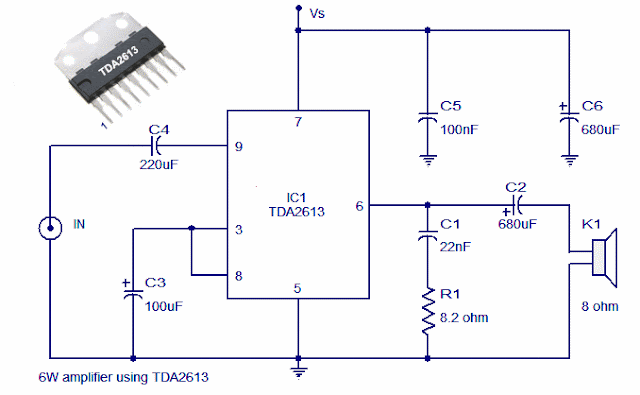
Reliable 6 Watt Hi Fi Audio Amplifier Using TDA2613

A 6 watt audio amplifier circuit using TDA2613 is shown here. TDA2613 is an integrated Hi-Fi  audio amplifier IC from Philips Semiconductors. The IC is switch ON / switch OFF click proof, short circuit proof, thermally protected and is available in 9 pin single in line plastic package. In the given circuit, TDA2613 is wired to operate from a single supply.

Capacitor C4 is the input DC decoupler while capacitors C5, C6 are power supply filters. Input audio is fed to the non inverting input through capacitor C4. Inverting input and Vp/2 pins of the IC are tied together and connected to ground through capacitor C3. Capacitor C2 couples the speaker to the ICs output and the network comprising of capacitor C1 and resistor R1 improves the high frequency stability.

Reliable 6 Watt Hi Fi Audio Amplifier Circuit diagram

6 Watt Hi Fi Audio Amplifier using TDA2613

Notes.
  • Assemble the circuit on good quality PCB.
  • Supply voltage (Vs) can be anything between 15 to 24V DC.
  • Heat sink is necessary for TDA2613.
  • Do not give more than 24V to TDA2613.

SRPP Headphone Amplifier Circuit Diagram

Mention valve amplifiers and many designers go depressive instantly over the thought of a suitable output transformer. The part will be in the history books forever as esoteric, bulky and expensive because, it says, it is designed and manufactured for a specific valve constellation and output power. There exist thick books on valve output transformers, as well as gurus lecturing on them and winding them by hand. However, with some concessions to distortion (but keeping a lot of money in your pocket) a circuit configuration known as SRPP (series regulated push-pull) allows a low-power valve amplifier to be built that does not require the infamous output transformer. SRPP is normally used for preamplifier stages only, employing two triodes in what looks like a cascade arrangement.

 SRPP Headphone Amplifier Circuit Diagram

Amplifier-Circuit-Diagram
Here we propose the use of two EL84 (6BQ5) power pentodes in triode SRPP configuration. The reasons for using the EL84 (6CA5) are mainly that it’s cheap, widely available and forgiving of the odd overload condition. Here, two of these valves are SRPP’d into an amplifier that’s sure to reproduce that ‘warm thermionic sound’ so much in demand these days.

Before describing the circuit operation, it must be mentioned that construction of this circuit must not be attempted unless you have experience in working with valves at high voltages, or can rely on the advice and assistance of an ‘old hand’. As a safety measure, two anti-series connected zener diodes are f it ted at the amplifier output. These devices protect the output (i.e. your head-phones and ears) against possibly dangerous voltages at switch-on,or when output capacitor C3 breaks down.

The power supply is dimensioned for two channels, i.e. a stereo version of the amplifier. The values in brackets are for Elektor readers on 120 VAC power. Note the doubled values of fuses F1 and F3 in the AC primary circuits. The PSU is a conventional design, possibly with the exception of the 6.3 V heater voltage being raised to a level of about +80 V through voltage divider R7-R8. This is done to prevent exceeding the maximum cathode-heater voltage specified for the EL84 (6CA5). R6 is a bleeder resistor emptying the reservoir capacitors C8 and C9 in a quick but control-led manner when the amplifier is switched off. Rectifier diodes D3–D6 each have an anti-rattle capacitor across them.

In the amplifier, assuming the valves used have roughly the same emission, the half-voltage level of about +145 V exists at the junction of the anode of V1 and the control grid of V2. The SRPP is no exception to the rule that high quality, (preferably) new capacitors are essential not just for reproducibility and sound fidelity, but also for safety.

Hybrid Headphone Amplifier Circuit Diagram

Potentially, headphone listening can be technically superior since room reflections are eliminated and the intimate contact between transducer and ear mean that only tiny amounts of power are required. The small power requirement means that transducers can be operated at a small fraction of their full excursion capabilities thus reducing THD and other non-linear distortions. This design of a dedicated headphones amplifier is potentially controversial in that it has unity voltage gain and employs valves and transistors in the same design. Normal headphones have an impedance of 32R per channel. The usual standard line output of 775 mV to which all quality equipment aspires will generate a power of U2 / R = 0.7752 / 32 = 18 mW per channel across a headphone of this impedance.

Hybrid Headphone Amplifier Circuit Diagram


Hybrid Headphone Amplifier Circuit Diagram


An examination of available headphones at well known high street emporiums revealed that the sensitivity varied from 96 dB to 103db/mW! So, in practice the circuit will only require unity gain to reach deafening levels. As a unity gain design is required it is quite possible to employ a low distortion output stage. The obvious choice is an emitter follower. This has nearly unity gain combined with a large amount of local feedback. Unfortunately the output impedance of an emitter follower is dependent upon the source impedance. With a volume control, or even with different signal sources this will vary and could produce small but audible changes in sound quality.

To prevent this, the output stage is driven by a cathode follower,based around an ECC82 valve (US equivalent: 12AU7).

This device, as opposed to a transistor configuration, enables the output stage to be driven with a constant value, low impedance. In other words, the signal from the low impedance point is used to drive the high impedance of the output stage, a situation which promotes low overall THD. At the modest output powers required of the circuit, the only sensible choice is a Class A circuit. In this case the much vaunted single-ended output stage is employed and that comprises of T3 and constant current source T1-T2.

The constant current is set by the Vbe voltage of T1 applied across R5 With its value of 22R, the current is set at 27 mA. T3 is used in the emitter follower mode with high input impedance and low output impedance. Indeed the main problem of using a valve at low voltages is that it’s fairly difficult to get any real current drain. In order to prevent distortion the output stage shouldn’t be allowed to load the valve. This is down to the choice of output device. A BC517 is used for T3 because of its high current gain, 30,000 at 2 mA! Since we have a low impedance output stage, the load may be capacitively coupled via C4. Some purists may baulk at the idea of using an electrolytic for this job but he fact remains that distortion generated by capacitive coupling is at least two orders of magnitude lower than transformer coupling.

The rest of the circuitry is used to condition the various voltages used by the circuit. In order to obtain a linear output the valve grid needs to be biased at half the supply voltage. This is the function of the voltage divider R4 and R2. Input signals are coupled into the circuit via C1 and R1. R1, connected between the voltage divider and V1’s grid defines the input impedance of the circuit. C1 has sufficiently large a value to ensure response down to 2 Hz. Although the circuit does a good job of rejecting line noise on its own due to the high impedance of V1’s anode and T3’s collector current, it needs a little help to obtain a silent background in the absence of signal.

The ‘help’ is in the form of the capacitance multiplier circuit built around T5. Another BC517 is used here to avoid loading of the filter comprising R7 and C5. In principle the capacitance of C5 is multiplied by the gain of T5. In practice the smooth dc applied to T5’s base appears at low impedance at its emitter. An important added advantage is that the supply voltage is applied slowly on powering up. This is of course due to the time taken to fully charge C5 via R7. No trace of hum or ripple can be seen here on the ‘scope. C2 is used to ensure stability at RF. The DC supply is also used to run the valve heater. The ECC82 has an advantage here in that its heater can be connected for operate from 12.6 V. To run it T4 is used as a series pass element. Base voltage is obtained from the emitter of T5. T4 has very low output impedance, about 160 mR and this helps to prevent extraneous signals being picked up from the heater wiring. Connecting the transistor base to C5 also lets the valve heater warm up gently. A couple of volts only are lost across T4 and although the device runs warm it doesn’t require a heat-sink.

Author: Jeff Macaulay - Copyright: Elektor Electronics

11 W Stereo or 22 W Mono Power Amp

Integrated AF power amps have seen great improvements in recent years offering improved power and easier use. The TDA1519C from Philips contains two power amplifiers providing 11 W per channel stereo or 22 W mono when the two channels are connected in a bridge configuration. The special in-line SIL9P package outline allows the chip to be conveniently bolted to a suitable heatsink. The TDA1519CSP is the SMD version, in this case the heat sink is mounted over, and in contact with, the top surface of the chip. 
11W Stereo Power Amp Circuit Diagram0111W Stereo Amplifier Circuit Diagram
The operating voltage of this device is from +6V to +17.5V. The two channels of the amplifier are different in that one channel, between pins 1 and 4, is a non-inverting amplifier, while the other between pins 9 and 6 is an inverting amplifier. It is therefore necessary in stereo operation, to wire the speakers so that one of them has its polarity reversed. Each amplifier has an input impedance of 60kΩ and a voltage gain of 40dB, i.e. 100 times. When both amplifier are used in a bridge configuration, the inputs are in parallel so that the input impedance will be 30kΩ.
 
A combined mute/standby function is provided on pin 8. In its simplest form this can be connected to the positive rail via a switch. When the switch is open the amplifier will be in standby mode and current consumption is less than 100µA. When the switch is closed, the amplifier will be operational. A circuit is also shown that uses the mute input to prevent the annoying switch-on plop heard when power amps are first switched on This is caused by the rush of current to charge capacitors C1 and C2.
Mute Standby Switch Circuit Diagram
Mute/Standby Switch Circuit Diagram

The circuit shown generates a ramp voltage, which is applied to pin 8. At switch on, as the voltage rises from 3.3 V to 6.4 V, the amplifier will switch out of standby mode and into mute mode allowing C1 and C2 to charge. Only when the ramp voltage on pin 8 reaches 8.5V will the amplifier switch into active mode. Protection built into the TDA1519C would seem to make it almost foolproof. The two outputs can be shorted to either of the supply rails and to each other. A thermal shutdown will prevent overloading and the power supply input is protected against accidental reversal of the supply leads up to 6V.
Author : G. Kleine  - Copyright : Elektor Electronics
Older Post ►
eXTReMe Tracker
 

Copyright 2011 Diagram Digital Schematic is proudly powered by blogger.com